
The 18-Month MISSE Delay
The 18-Month MISSE Delay: How Mexico Just Converted Social Friction into a Binding Liability

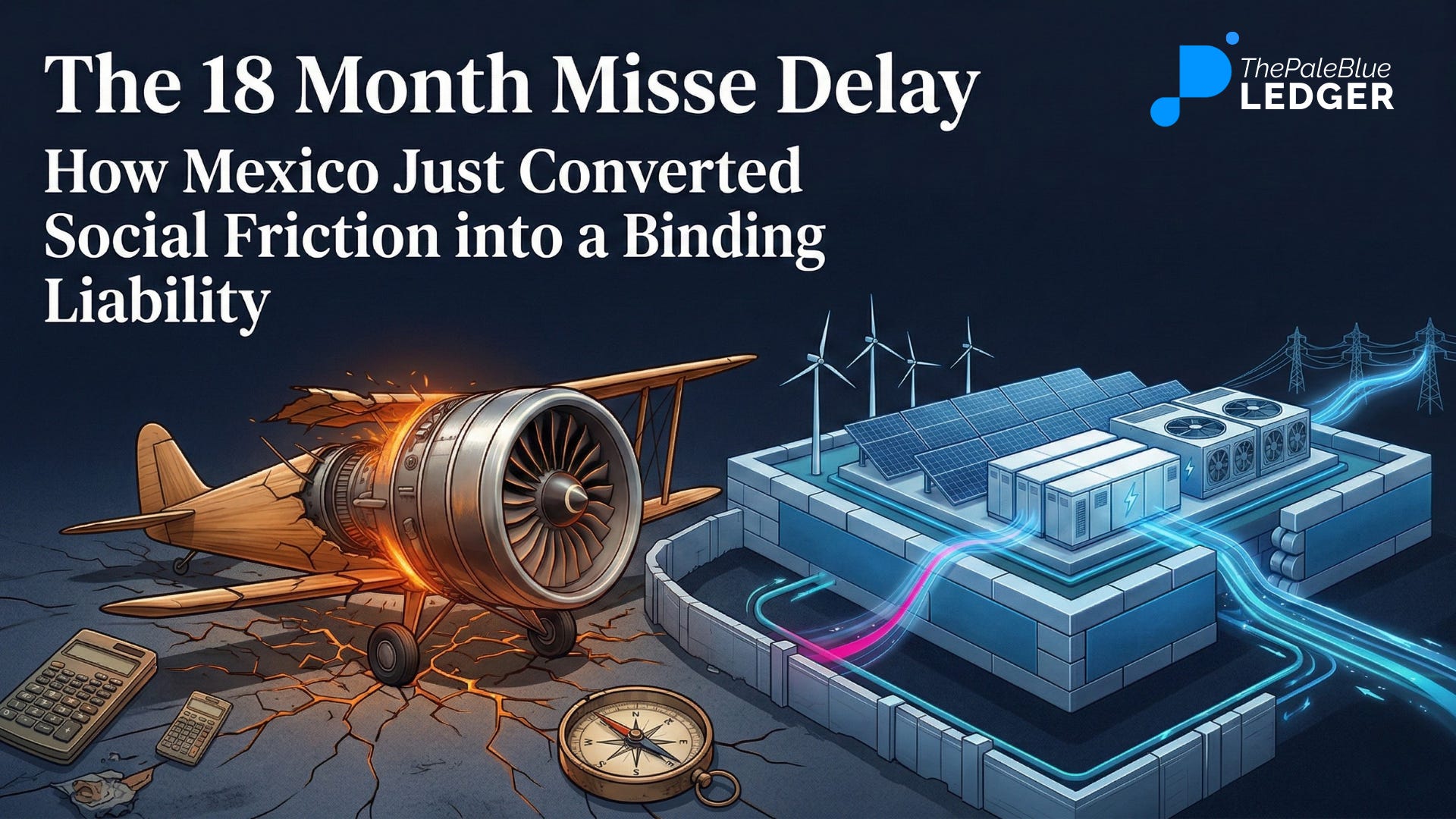
Since February 17, every financial model for Mexican energy infrastructure that treats community relations as a soft, off-balance-sheet variable has become mathematically obsolete.
The publication of the MISSE 2026 framework did not just change a permitting checklist; it fundamentally re-engineered the capital stack for energy development. Under the previous EvIS regime, developers could map out perfect thermodynamic yields and relegate social friction to an unquantified public relations budget. That asymmetry is gone. The state now requires a formalized plan where the capital committed to shared benefits must equal or exceed the financial cost of mitigating negative impacts.
Social friction is no longer an abstract operational annoyance; it is now a legally binding, verifiable capital expenditure (CAPEX) line item, which refers to funds used by a company to acquire or upgrade physical assets. It is a legally binding, verifiable CAPEX (capital expenditure) line item.
The market consensus is currently reading the matter as a bureaucratic gridlock. It is easy to look at the new twelve- to eighteen-month approval timelines and assume the system is seizing up. That linear expectation misses the actual mechanics at play. The system is not failing; it is aggressively clearing out undercapitalized speculation. For years, highly leveraged developers crowded the interconnection queues, relying on the assumption that they could externalize the costs of local opposition to make their unit economics look attractive.
Now, the baseline has accelerated beyond that fragile governance model. You cannot extract high-density energy from a location without engineering the social stability required to maintain that flow. The new regulation simply forces the spreadsheet to reflect the physics of the site.
This shift forces a hard pivot in how we value assets. The immediate economic consequence is not that projects become impossible, but that the entry fee for operational continuity has been formalized.
The real risk lies in the latency of ignoring this upgrade for a fund partner deploying capital or a plant manager installing behind-the-meter solar. If your EPC vendor or development partner has not already priced this hard social CAPEX into their IRR calculations, you are funding a hallucination. The returns look great right up until a community veto or a regulatory audit stops the electrons from flowing.
In a high-density energy market, verifiable social investment is no longer a public relations luxury; it is the structural insurance premium required to guarantee uninterrupted thermodynamic output.
Most industry panic is a reaction to old facts. It is a reaction to using an old map for new terrain.
The prevailing narrative across Mexico City boardrooms is entirely rational. Legal teams read the February 16 publication of the MISSE and see a bureaucratic wall. They calculate that the expansion of permitting timelines has increased from the historical six to eight months under the EvIS to a new reality of twelve to eighteen months. They note that social compliance costs will at least double. Financial models based on extremely thin margins abruptly collapse. Analysts immediately frame the incident as a targeted barrier to private investment.
They point to the upcoming 2026 USCMA (T-MEC) review and warn of catastrophic investor flight. It sounds perfectly logical. The terrain has changed. The actual bottleneck restricting Mexico's energy matrix is not the speed of the permitting process.
The terrain has changed. The actual bottleneck restricting Mexico’s energy matrix is not the speed of the permitting desk. The bottleneck is the allocation of scarce grid capacity to fragile, undercapitalized projects that inevitably fail during deployment due to localized social blockades. The state is not trying to stop infrastructure. The state is recalibrating the social CAPEX floor to protect the grid. Look at the specific design parameters. The new framework mandates that the financial commitment to shared benefits must equal or exceed the cost of mitigating negative impacts. It forces utility-scale battery storage above 250 MWh into the highest compliance bracket, Formato C.
Indigenous communities now hold a binding veto over project authorizations. This is not arbitrary bureaucracy. This is a highly efficient speculator filtration mechanism. It weaponizes time and upfront capital to purge highly leveraged paper projects from the interconnection queue.
Serious capital allocators must adjust their instruments. If an infrastructure fund is panicking about a twelve-month delay, that fund is structurally misaligned with the physics of the Mexican market. The barrier to entry has simply been formalized. The developers complaining the loudest are the ones who relied on externalizing community risk to artificially inflate their IRRs.
The pragmatic elite will let those developers bleed out in the queue. They will buy the abandoned interconnection rights at a discount. They will deploy capital into projects where the social physics have been engineered and priced with the same rigor as the thermodynamic yield.
When the output capacity of an engineered asset exceeds the structural tolerance of its surrounding environment, the asset does not simply underperform—it fractures.
For decades, infrastructure developers treated the physical grid and the local community as two entirely separate dimensions of reality. You bought the turbines, you poured the concrete, and you hired a communications firm to manage the locals. That separation is now mathematically extinct. We have crossed into the era of thermodynamic continuity.
This is not a rebranded sustainability metric or an updated compliance checklist. It is a fundamental recalculation of what constitutes a functioning energy asset. It dictates that the physical flow of electrons is inextricably locked to the formalized, capitalized stability of the social perimeter.
Consider the engineering reality of a high-bypass jet engine. You cannot bolt a modern titanium turbine onto a wooden biplane airframe. The sheer torque and thrust will tear the fuselage apart before the aircraft ever leaves the tarmac. The engine’s physics are flawless, but the surrounding architecture lacks the load-bearing capacity to sustain the output. This is precisely what is happening to Mexican energy infrastructure under the new regulatory framework.
Developers are trying to bolt highly advanced, capital-intensive generation and storage assets onto environments that lack the social and legal load-bearing capacity to absorb them.
Legacy competencies do not transfer to this new physics. The skill required to navigate a desk audit in a capital city is entirely detached from the skill required to engineer a verifiable, audited social baseline on the ground. A perfectly engineered 300 MW solar plant integrated with a utility-scale 250 MWh battery system is a financial liability, not an asset, if a localized blockade or a binding indigenous veto cuts its output to zero.
This mechanical reality translates directly to the balance sheet. Under the new regulatory mandate, the investment required to secure this load-bearing capacity is no longer discretionary. It is a rigid, audited obligation where the capital deployed for shared benefits must equal or exceed the financial cost of mitigating negative impacts.
Capital flows are currently splitting into two distinct streams based on this exact threshold. Those who optimize for legacy installed capacity are bleeding out in eighteen-month interconnection queues, watching their projected IRRs disintegrate as they attempt to negotiate away the physics of their environment.
Those who build for thermodynamic continuity treat the social investment exactly like they treat the steel, the silicon, and the transformers. It is a non-negotiable hard cost required to purchase localized systemic stability. They secure the operational perimeter before they commit a single dollar to the core.
The transition window between these two states of capital allocation is brief and entirely unforgiving. The market is currently populated by legacy operators who still believe they can lobby, litigate, or negotiate their way out of physical and regulatory constraints. By the time they realize the environment has permanently hardened, the capital allocators who priced in the new physics will have already secured the viable interconnection nodes and neutralized the operational friction.
The map has been permanently redrawn, and the grid will only accept infrastructure that guarantees its own survival.
Every mechanical system that accelerates its throughput inevitably generates thermal resistance at its physical contact points. The Mexican energy sector has rapidly increased the density and scale of its intended infrastructure, and the resulting friction—manifesting as the stringent requirements of the MISSE 2026 framework—is simply the heat generated by that growth.
Consider the temporal mismatch in how project development teams are currently assembled. For years, engineers and project managers were trained to navigate the EvIS regime, operating on assumptions of six- to eight-month approval cycles where social impact was treated largely as a localized public relations exercise.
That foundational knowledge base is now structurally obsolete. The market velocity today demands rigorous, verifiable socio-demographic data collection, continuous annual reporting, and strict financial matching for impact mitigation. Yet, the talent pool arriving at the gates—from universities and legacy consulting firms—is still mentally optimized for a regulatory environment that ceased to exist on February 16. As soon as talent arrives with an outdated operational model, the organization must bear the cost of bridging the gap between legacy theory and current physics, which causes a severe distortion.
This temporal lag immediately triggers a severe distortion in price signals. We are currently seeing the projected cost of social management and compliance effectively double. Operators are reacting to this pressure by throwing aggressive capital at specialized legal and social labor, attempting to brute-force their way through the heavy documentation requirements of Formato B and Formato C. But escalating labor and consulting costs are rarely just inflation; they are a diagnostic signal. When the cost of manually negotiating community agreements and drafting hundreds of pages of socio-economic justification becomes prohibitive, the system is screaming that it has reached the limits of manual intervention. The rising wages of crisis managers and regulatory fixers indicate that the market is desperately demanding structural capital substitution, not just an expansion of billable hours.
This leads directly to the absolute biological limits of human exposure in project development. The sheer volume of data required to maintain thermodynamic continuity is staggering. A pipeline that includes behind-the-meter solar arrays requiring Formato A compliance, alongside utility-scale 250 MWh battery systems suddenly burdened with massive Formato C demands, requires continuous, hyper-local monitoring. A human development team cannot manually process the localized socio-political variables necessary to preempt a binding indigenous veto across multiple regions. The cognitive and physical bandwidth of an executive team simply maxes out when trying to maintain manual oversight of annual compliance indicators across a distributed portfolio. The infrastructure has scaled beyond the capacity of traditional human relationship management.
This temporal lag, the spiraling cost of manual compliance, and the exhaustion of human bandwidth are not signs of managerial failure. They are a precise topographical map of the new regulatory terrain.
The organizations that learn to read this structural friction as a strict design parameter will inherently outpace those that exhaust their capital trying to fight it.
Strategic advantage now comes from how fast an organization can translate regulatory friction into an automated manufacturing process.
The financial arbitrage of the new regulatory framework is brutal and binary. Legacy operators treat the new mandates as an operational expense, absorbing the projected doubling of social management costs by deploying armies of external consultants. This destroys project margins before a single panel is installed. First movers execute a different logic: they treat compliance as a CAPEX investment. By engineering a systematized social underwriting engine, they flatline their unit costs per megawatt while competitors drown in compounding, manual OPEX.
Execute the CapEx Flip immediately. Reallocate spending from reactive legal labor to internal data infrastructure. The new framework requires continuous annual reporting and strict financial tracking to ensure social investment matches impact mitigation. Manually compiling this data for every asset is a margin killer. Build or acquire software that programmatically tracks local socio-economic indicators and ties them directly to the project’s financial model. Treat the social baseline as a core physical asset on the balance sheet, not an outsourced HR function.
Enforce the Machine-First Standard across the portfolio. The documentation demands of Formato C—now explicitly required for critical infrastructure like battery storage exceeding 250 MWh—exceed biological processing bandwidth. No human is assigned to manually scrape municipal data, map overlapping territories, or calculate the financial baseline of shared benefits. Automate the dull, data-heavy underwriting.
Reserve human capital strictly for high-leverage interventions, such as securing the actual binding consent from indigenous communities to prevent the newly established regulatory veto. Humans supervise the risk engine; they do not act as its cogs.
Establish competency lock-in to protect the new baseline. Legacy talent trained for the outdated six-to-eight-month approval cycles of the EvIS regime currently floods the market. Do not wait for universities or consulting firms to update their curricula. Construct an internal academy that trains your engineering and finance teams to price thermodynamic continuity. Develop proprietary, cross-functional workflows where electrical engineers and social underwriters work from the exact same integrated financial model to navigate the new twelve- to eighteen-month development cycles, which are the timeframes for completing projects from start to finish. When your team knows how to successfully execute within these strict parameters while competitors fail, you achieve retention through extreme market relevance.
This is not theoretical posturing. Infrastructure data from institutions like Lazard and McKinsey consistently show that the highest IRR degradation in emerging markets stems from non-technical, localized friction. The capital allocators who recognize this are already moving to internalize these capabilities, turning regulatory barriers into defensive moats.
Are you building an organization optimized for last cycle’s labor market—or for the system you are already operating inside?
TL;DR: Key Insights on The Structural Arbitrage of MISSE 2026
The MISSE 2026 framework legally mandates that financial commitments to shared benefits must equal or exceed the cost of mitigating negative impacts. This irreversibly converts community relations from an off-balance-sheet public relations expense into a binding CAPEX liability.
The market consensus incorrectly reads the new twelve- to eighteen-month approval timelines as a bureaucratic failure that will stall private investment. In physical reality, this friction acts as a ruthless speculator filtration mechanism to purge undercapitalized paper projects from the grid queue.
Legacy operators who attempt to manage this shift by hiring external consultants will destroy their project margins through compounding manual OPEX. First movers will capture the abandoned interconnection rights by pricing thermodynamic continuity as a core engineering cost that guarantees uninterrupted asset output.
Cease manual compliance efforts immediately and execute the CapEx Flip by reallocating reactive legal spend into automated data infrastructure. Systematize the baseline socio-economic underwriting to reserve human capital exclusively for securing the binding community consent required to prevent a regulatory veto.